Showing posts with label N2CQR. Show all posts

Monday, April 19, 2010

Jeff's Second Visit to my Hanger/Shop

Yesterday, I had a fellow HAM "drop by" my Hanger/Shop - Jeff - KO7M.  This was Jeff's second visit to the Shop, But this time he flew in via his Piper Cub!

 A Repeat Visitor to My Hanger/Shop

It was grand to see Jeff and his airplane, it is immaculate, extremely well maintained.

Jeff - KO7M - with his CUB

There is still to much brush to try to taxi up to down to the hanger, as seen in the background below, as it was, we had to bushwhack a little on each side of the drive, just to let Jeff return to the taxiway.


This is only the second airplane that has ever been on my hanger driveway, only my own C-182 RG (about 15 years ago) was the other.

We did not do much HAM Radio work while Jeff was there, but the event was made possible by a mutual enjoyment of HAM Radio, as we met about a year ago as a results of each listening to;  Bill - N2CQR - of SolderSmoke Podcast fame.  Thanks Bill.

Because I have now moved my Shop to the airport, I have plans to re-kindle my interest in flying - and maybe, just maybe, you will hear me on 30m QRP CW as - WA0UWH / AM from a knee key!

Jeff's Departing Wing Wave 
From maybe 2000 feet above
It is not CW, but universally well understood!


73 K07M/AM de WA0UWH


UPDATE:

I got to thinking about the "Wing Wave" - it has probably communicated more "welcomed information" than any other used message format (and for it's duration) than that which has ever been used.  And, it is perhaps the most universally understood - regardless of the pilots language or actual intended message. In a disport situation this is the message that I would want to receive.

--

Thursday, July 23, 2009

ET Phone Home

An archived Letter to Bill - N2CQR - of SolderSmoke fame regarding my entry for the ET Phone Home event. This was sent before I started this blog and I have posted it here as an archive.

Bill, In keeping with the spirit of QRP, QRSS and the minimalist HB challenge of ET-Phone-Home I have enlisted one of my single-transistor-nine-volt (2N3904) QRP rigs.

With the best that I can measure, this system has a DC "input power" of 6.84mw into a 16 inch loop antenna of 30 AWG copper coated-steel MIG welding wire. On previous experiments, the Tx was easily detected from 1500 feet away from on my grabber.  Longer DX experiments have not yet been conducted.

Note as per the photos, I have cheated a little, the Tx rig that I selected to used, was from a previous project, and has an additional active element, a five volt regulator (LM7805) for oscillator stability and battery longevity (i.e the 9 volt battery voltage can decrease down to 7 volts and oscillator requires only 1.8ma before the Tx frequency goes unstable).

Bill, The QRSS frequency modulation technique that I used is the same that I suggested for you to invert your FSK MEPT transmitter signal - for up frequency modulation - increase the "capacitance to ground at the collector" of the oscillator ( which I think cancels some of the normal colpitts crystal oscillator capacitance - and therefore the frequency goes up with increased capacitance ). My modulation requirement does not need a "gimmick" as you have used, because of my use of direct mechanical capacitance coupling (as described below).
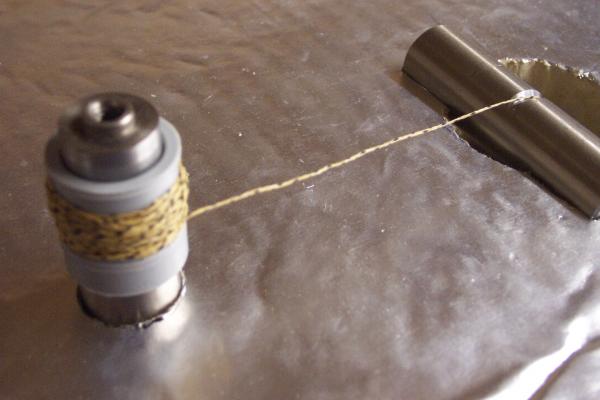
To power modulation my system uses about 8 gallons of water in a 6 inch reservoir with trickle flow bypass regulation around a weighted falling piston, which pulls on a string, which turns the encoder.

The Water Colum
The piston is large "Whole Fancy Indian - Cashew - Premium Quality, All Natural" nut container ( obtainable from the actual Kirkland Costco store ) with Velcro (loops) Sticky tape wrapped around the top and bottom bulges providing the snug fit and trickle flow metering in the water column. About 8 lbs of weight was added to the nut container to provide the necessary potential-energy storage.

The Piston
This system of metering and energy storage provides for a run-time of about 10 minutes, before a mechanical reset is necessary (note to potential builders, performance and timing formulas are not included within this document ).

Following ET's example, the encoder is a 10 inch multi-cut rotating disk encoder - model number 9-32636 (only obtainable from Sears) augmented with "replaceable-movable-removable" coding elements attached with tape. Before the coding elements were installed on the modulation encoder, the system produce a QRSS "Saw Tooth" waveform (what else would you have expected?), which was initially used just for testing (see: the additional oscillator mounting hole on the substrate, closer to the pivot point ).
The Turn Table
The Turn Table Drive
Note, this encoder technique requires no actual physical or switch contact with the Tx. Only a ground and collector capacitor plates were extended from the colpitts oscillator to form the modulation active elements. I originally was planning to encode my own call - "WA0UWH", but the encoder blade could not hold that much data. A blade upgrade is being considered (i.e., 12 inch).


The FSK Modulator
For now, I have chosen something shorter and simpler to encode (as ET would have suggested), I will use my QTH as the name of the nearest major landing-site in my area with high intensity approach lights - SEA (Seattle International Airport), besides it was much easier to cut from PC stock - 5 dots and a dash.

"SEA" Encoded
Note: the selected message can be shortened by folding the unused elements onto the center of the modulation blade (Note to self - other messages could be encode using the same elements and a similar folding technique, that is "ET" could be encode from the "SEA" elements ).

The resulting modulation is not as square as traditional QRSS3 digital driven keyers, but, . . . it is very distinctive.
The FIRST major modification to this system was the addition of a rolling cart for transport, I had to move the reservoir to a stairs where I could get above it, to pull up and reset the modulator piston, which by the way requires about a 20 lb pull for about the same duration as the run time (about 10 minutes).

The NEXT major modification WILL BE a maximum flow (3/4 inch) tickle flow "bypass" pipe via a control "valve" to aid in the reset process ( for the European critics, I do not think this should be mistaken nor counted as an active QRP element ).  This will make the resetting process go much smother, quicker, and should require much less external "arm strong" input power (question: where does the input power go?? warming the water??).

The MEPT QRSS operation is simple; Raise the piston (lock it in place), Wind up the draw string around the pulley, Install the encoder disk, Release the lock, and then Wait for the DX grabber reports?

Note: a complete set of construction, operation photos and grabber images will be added to my Gallery when time permits: http://www.metplx.com/WA0UWH/Photos/

NOTE: For others HB'ers interested in this project, Kits WILL NOT be made available.

Bill, watch for my signal on the 30M grabbers - it should be very recognizable as my signal will have a bit of a "Saw Tooth", waveform component.

SEA SEA SEA SEA S

More details may follow as the project progresses (to where, I am not sure, but I do know that this is enough of this!).
Bill, It has been fun !! 73's - Eldon - WA0UWH - alias "SEA" Phone Home
In Operation with Small Loop Antenna
73's Eldon - WA0UWH
PS: No actual grabbers were harmed while collecting data for this document, but a 30db attenuator was added to the antenna connection on my SA602 DC receiver for its near field overload input protection :-)

--